by David Ezra Stein
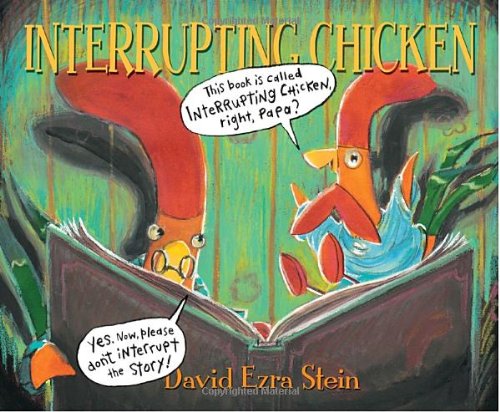
Bibliography:
Stein, D.E. (2010). Interrupting chicken. Somerville, Mass.: Candlewick Press.
Summary:
Little Red Chicken wants a bedtime story read to him so he can go to sleep, but he keeps interrupting his dad and cutting each story short.
My impressions:
This book is so entertaining. The illustrations are clever with Little Red Chicken interrupting each story right on the page where his father is reading. It looks as if he is drawing on the page as he blurts out his ending to the story. You can feel the flow of each story abruptly take a screeching halt. The story is cute but the illustrations are what make it so enjoyable.
Reviews:
Karre, M. (2011). Interrupting Chicken. School Library Journal, 57(6), 59-60.
It's bedtime for little red chicken, but she is more interested in saving the characters in the fairy tales that Papa is reading than in relaxing and going to sleep in this picture book (Candlewick, 2010) by David Ezra Stein. As Papa reads, Little Chicken can't help interrupting the stories to warn Hansel and Gretel and Little Red Riding Hood of impending dangers, and to reassure Chicken Little that a falling acorn is not the end of the world. Thus, she ends each story prematurely, until Papa runs out of tales, and suggests that Little Chicken tell him a story. Ironically, her story succeeds in putting Papa to sleep, and ends this tale. Andrew Watts does a good job of differentiating between Papa's mellow voice, Little Chicken's lighter interjections, and the screechy witch's and the gruff wolf's voices. Page-turn signals are optional. Stein's humorous, vivid illustrations contrast the classic tales with the ongoing story--so be sure to have the book available. Youngsters will want to hear this story again and again.
Van Vleck, G. (2010). Interrupting Chicken. School Library Journal, 56(7), 69.
In a picture book that is as charming and comic as Pouch! (Putnam, 2009), Stein again represents an affectionate parent's trials with a vigorous child. At bedtime, despite a rooster papa's best efforts to share classic fairy tales with his daughter, Little Red Chicken's soft heart means she can't help but jump into each story to warn Hansel and Gretel and then Red Riding Hood about impending danger, and to assure Chicken Little: "Don't panic! It was just an acorn." In each case, the story abruptly ends, wearying the father with what to do next. When he convinces his daughter to compose her own story, she fills four pages with preschool-style spelling and drawings about a chicken putting her papa to bed, but her tale is interrupted by Papa's snores. At the end, the pair cuddle together, asleep. Stein's droll cartoons use watercolor, crayon, china marker, pen, and tea. The rich colors of the characters perfectly contrast with the sepia pages of the storybooks. This is one of the rare titles that will entertain both parent and child.
Suggestions for use:
I think this could be used with a lesson in the library about how not to interrupt when when the librarian is reading or other people are talking. After reading the book and discussing, there could be some role playing with one child reading and another constantly interrupting to demonstrate how it interferes with everyone's listening.
